
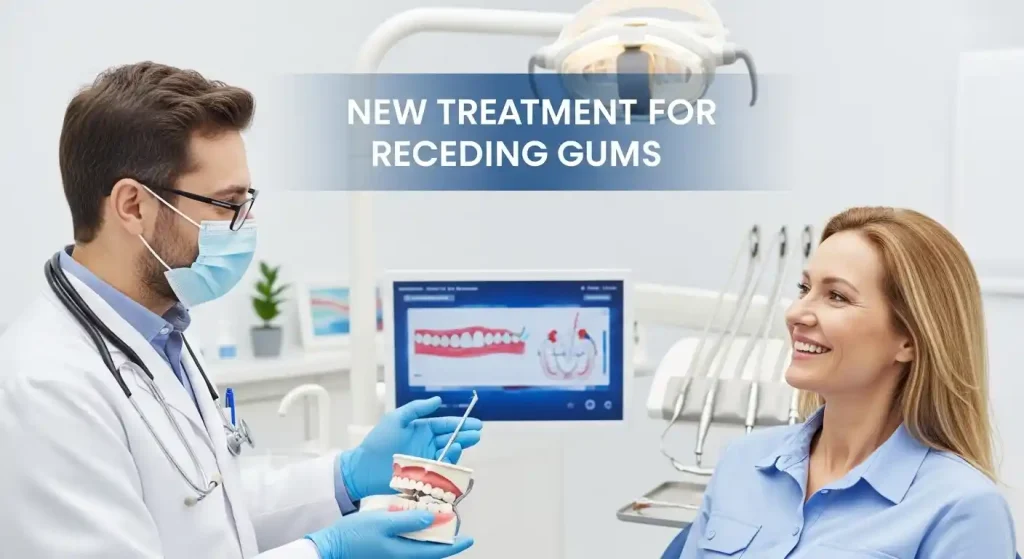



Receding gums do not normally grow back on their own. However, modern dental treatments can stop the condition from getting worse, protect exposed tooth roots, reduce sensitivity, and restore some gum coverage. Treatment may include deep cleaning, dental bonding, gum grafting, collagen materials, platelet-rich fibrin, or a minimally invasive root-coverage procedure.
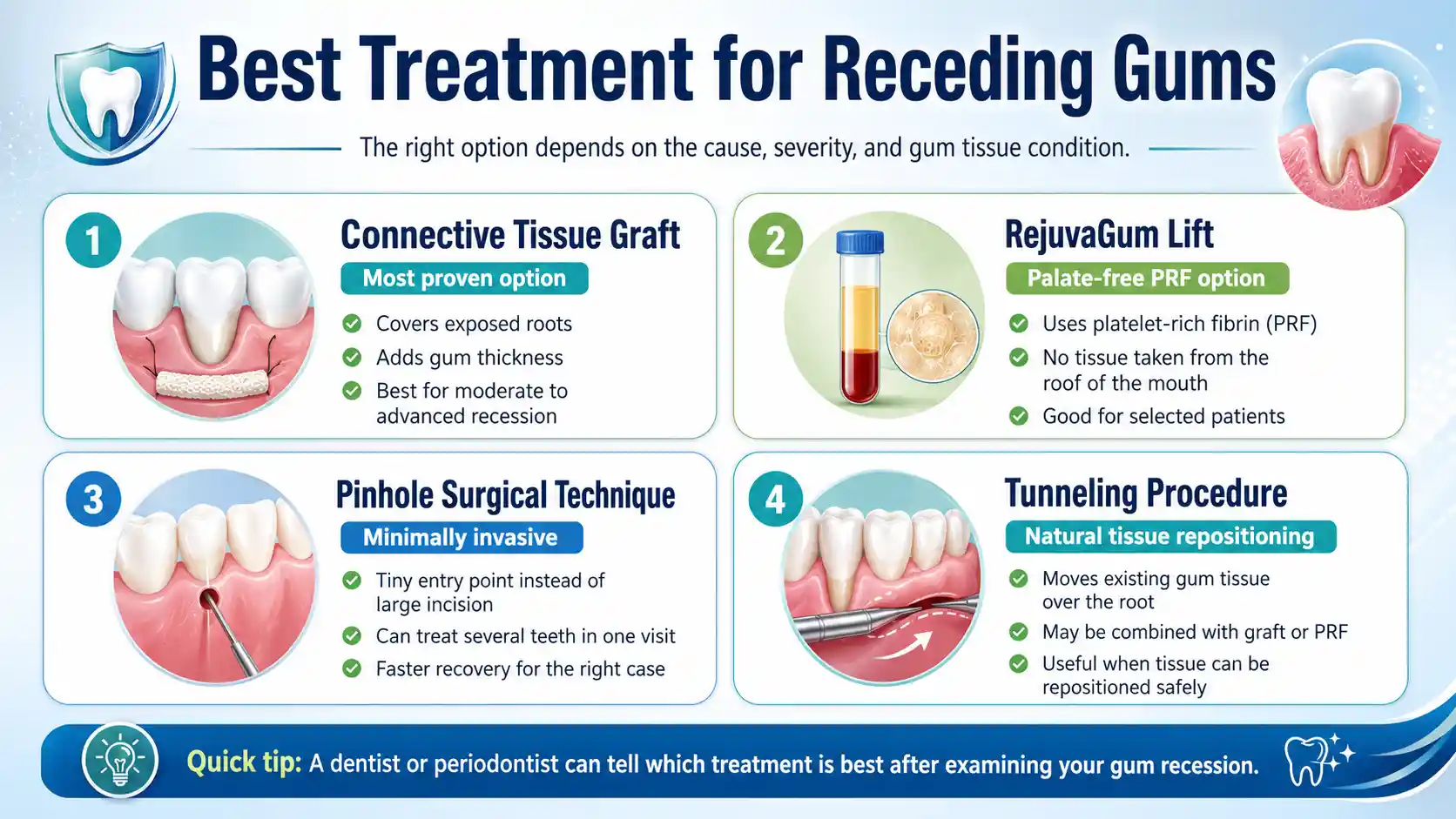
RejuvaGum Lift is one newer option attracting attention. It uses platelet-rich fibrin, or PRF, made from the patient’s blood instead of removing graft tissue from the roof of the mouth. Other treatments include connective tissue grafting, tunneling procedures, the Pinhole Surgical Technique, and laser treatment when gum disease is contributing to tissue loss.
The best treatment depends on why your gums have receded, how much root is exposed, how healthy the surrounding bone and tissue are, and how many teeth are affected. A dentist or periodontist must examine the area before determining whether a newer treatment or a traditional gum graft is more suitable.
What Are Receding Gums?
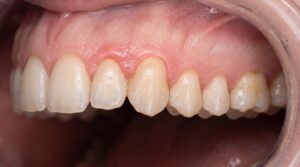
Gum recession happens when the gum line moves away from the tooth and exposes part of the root. This can make the tooth look longer than before.
The root does not have the same protective enamel that covers the visible crown of the tooth. As a result, exposed roots may be more sensitive to hot, cold, sweet, or acidic foods. They can also become more vulnerable to wear and root decay.
Gum recession may affect one tooth, several neighbouring teeth, or areas throughout the mouth. It can develop slowly, which means some people do not notice it until the roots become visible or sensitivity begins.
Treatment is important because the lost gum tissue usually does not return without a professional root-coverage procedure. Gum grafting and other periodontal treatments can protect exposed roots and help prevent additional tissue loss.
What Is the Best Treatment for Receding Gums?
The best treatment is the one that addresses both the cause and the amount of tissue loss.
Mild, stable recession may only require monitoring, gentler brushing, sensitivity control, and treatment of any inflammation. Moderate or advanced recession may need a procedure to cover the exposed root.
The following table provides a simple comparison.
| Treatment | May Be Used For | Main Limitation |
| Desensitizing toothpaste | Mild root sensitivity | Does not restore lost tissue |
| Deep cleaning | Recession linked to periodontal disease | Does not always cover exposed roots |
| Dental bonding | Protecting or hiding an exposed root | Covers the root without rebuilding gum tissue |
| Orthodontic treatment | Recession related to tooth position | Not suitable for every case |
| Connective tissue graft | Predictable root coverage and added tissue thickness | Requires a surgical procedure |
| Donor tissue or collagen matrix | Avoiding tissue removal from the palate | Results may differ from an autogenous graft |
| RejuvaGum Lift | PRF-assisted treatment without a palate tissue graft | Availability and supporting evidence are more limited |
| Pinhole or tunneling procedure | Repositioning existing gum tissue | Requires enough healthy tissue and proper case selection |
| LANAP | Periodontitis and related attachment loss | Not a standard root-coverage procedure |
A periodontal examination may include measurements of the recession, gum thickness, periodontal pockets, tooth position, bite forces, and bone support. These details help determine whether the area can be monitored or needs active treatment.
How Much Does Receding Gum Treatment Cost?
The cost to fix receding gums varies widely because the phrase covers several different treatments.
| Treatment | Cost Considerations |
| Examination and imaging | Depends on the office and insurance coverage |
| Deep cleaning | Depends on the number of areas and severity of gum disease |
| Dental bonding | Usually priced by the number of teeth treated |
| Traditional gum graft | Depends on graft type, number of teeth, and case complexity |
| RejuvaGum Lift | No standard public price; generally compared with graft treatment |
| Pinhole or tunneling | Depends on the number of teeth and material used |
| LANAP | Depends on how much of the mouth requires periodontal treatment |
| Collagen or donor material | May add material fees to the surgical cost |
A 2024 U.S. consumer estimate placed the average total cost of gum graft surgery at about $2,742, with a reported range of approximately $2,120 to $4,982. This is not a guaranteed local price, and current fees may be higher or lower.
Ask the office for a written treatment estimate that includes:
- The number of teeth or treatment areas
- The type of graft or material
- Examination and imaging fees
- Sedation, if needed
- Follow-up visits
- Insurance estimates
- Available payment options
Choosing treatment based only on the lowest price may lead to poor case selection. The provider’s experience and the expected long-term result also matter.
What Causes Gums to Recede?
There is no single cause of the gum recession. In many cases, more than one factor is involved.
Gum Disease
Periodontal disease can damage the gum tissue and bone that support the teeth. As the condition progresses, the gums may pull away and expose the roots. Treating the infection is usually the first step. Covering the root without controlling active gum disease may not provide a stable long-term result.
Brushing Too Hard
Using a hard-bristled toothbrush or applying too much pressure can wear away thin gum tissue over time. Brushing harder does not clean the teeth better. A soft-bristled toothbrush and controlled pressure are usually safer for the gum line.
Thin Gum Tissue
Some people naturally have a thinner gum type. Thin tissue may be more likely to recede when exposed to brushing pressure, tooth movement, inflammation, or other stress.
Tooth Position
A tooth that sits too far forward or outside the ideal bone position may have less gum and bone covering its root. Orthodontic movement may help in selected cases, although the gum tissue must be evaluated before treatment.
Teeth Grinding
Grinding and clenching can place extra force on the teeth and supporting structures. It may not be the only cause of recession, but it can make an existing problem harder to manage.
Smoking and Tobacco Use
Smoking affects blood flow and the way gum tissue responds to infection and healing. Tobacco use can also make gum disease harder to detect because smokers may have less visible bleeding.
Oral Piercings and Local Injury
Lip and tongue jewelry can repeatedly rub against the gum line. Dental trauma, poorly shaped restorations, and repeated irritation may also contribute to localized recession.
These causes and risk factors should be identified before choosing a treatment. Correcting the tissue loss without addressing the cause increases the chance that recession will continue.
Warning Signs of Gum Recession
The most noticeable sign is a tooth that looks longer than it did before. Other possible signs include:
- A visible yellow or darker area near the gum line
- Sensitivity to cold, heat, sweets, or brushing
- A small notch where the tooth meets the gum
- Food collecting near an exposed root
- Bleeding or swollen gums
- Pain during dental cleaning
- A loose tooth in more advanced cases
Bleeding is not always caused by recession itself. It may indicate gingivitis or periodontal disease, which needs to be treated separately. Schedule a dental examination if the roots are becoming more visible, sensitivity is increasing, or the gums are changing around one or more teeth.
Can Receding Gums Grow Back?
Receding gums do not normally grow back naturally. Toothpaste, supplements, massage, oils, and mouthwash cannot move a lost gum line back over an exposed root. However, receding gums can often be repaired or managed professionally.
A dentist may use bonding to cover the root and reduce sensitivity. This protects the exposed area but does not replace missing gum tissue. A periodontist may use a gum graft, re positioned gum tissue, PRF, a collagen matrix, or another root-coverage technique to improve protection and appearance. The expected amount of coverage depends on the recession defect and the condition of the surrounding tissue and bone.
What Is the RejuvaGum Lift?
RejuvaGum Lift is a branded procedure designed to treat gum recession without removing connective tissue from the roof of the mouth.
A small amount of the patient’s blood is collected and processed to create advanced platelet-rich fibrin. PRF contains a fibrin structure along with platelets and natural components involved in healing. The concentrated PRF is placed around the treated recession area to support healing and soft-tissue repair. Because the material comes from the patient’s blood, a separate palate tissue donor site may not be required.
RejuvaGum Lift should not be described as a completely nonsurgical treatment or guaranteed gum regrowth. The amount of root coverage can vary based on the recession type, surgical technique, tissue thickness, bone support, oral hygiene, and healing response.
Research supports the use of advanced PRF in treating certain recession defects. However, a 2024 systematic review found that connective tissue grafts produced better results for complete root coverage and gains in keratinized tissue in the studies reviewed. PRF may still be a useful option for selected patients who want to avoid tissue removal from the palate.
How Much Does RejuvaGum Lift Cost?
RejuvaGum Lift does not have one published nationwide price.
The total may depend on:
- The number of teeth being treated
- The depth and width of the recession
- Whether one area or several areas are involved
- The provider’s training and location
- Imaging and examination fees
- The exact surgical method used
- Follow-up visits
- Whether additional periodontal treatment is needed
The provider associated with the branded procedure describes its price as generally comparable to traditional graft treatment rather than listing one fixed fee.
Patients should request a written estimate after an examination. The estimate should explain what is included, whether follow-up visits are covered, and whether an insurance claim can be submitted.
Insurance coverage varies. A plan may contribute when treatment is needed to protect the tooth or manage periodontal disease, but cosmetic treatment may not be covered.
What Do RejuvaGum Lift Before-and-After Results Show?
RejuvaGum Lift before-and-after photos may show a fuller gumline and less visible root surface. However, photos cannot guarantee that another patient will receive the same result.
When reviewing treatment photos, look for:
- Cases involving a similar type of recession
- Photos taken from the same angle and distance
- Similar lighting in both images
- Clear treatment dates
- Information about how long the result was followed
- Measurements of root coverage, not only visual claims
The condition of the bone and tissue between the teeth affects how much coverage may be possible. Deep or complex recession defects may be harder to cover completely.
Patients should also ask whether the published result required one procedure or several treatments.
What Are the Alternatives to Traditional Gum Grafting?
People often search for alternatives because they want to avoid tissue removal from the roof of the mouth. Several options may be available, but many are still clinical procedures.
Donor Tissue
Processed donor tissue can sometimes replace tissue taken from the patient’s palate. This avoids a second surgical site. The material still needs to be placed and secured over the recession area.
Collagen Matrices
A dentist may use a specially manufactured collagen matrix as a scaffold for soft-tissue healing. This is not the same as taking a collagen supplement or brushing with collagen tooth powder. Clinical collagen matrices are medical materials placed during a periodontal procedure.
Research suggests that collagen matrices can improve root coverage in selected cases. Connective tissue grafts may still provide greater tissue thickness or more predictable coverage in some situations.
Coronally Advanced Flap
With a coronally advanced flap, the dentist loosens existing gum tissue and moves it toward the crown of the tooth to cover the exposed root. The procedure may be performed alone or combined with connective tissue, PRF, or another material.
Tunneling Procedure
A tunneling technique creates space beneath the existing gum tissue without fully separating the gumline. The tissue can then be repositioned over the root. A connective tissue graft, collagen material, or PRF may be added depending on the case.
Pinhole Surgical Technique
The Pinhole Surgical Technique uses a small opening in the gum. Special instruments are inserted through this opening to loosen and reposition the tissue over exposed roots.
It may avoid large incisions and can sometimes treat several neighboring teeth in one visit. However, it still requires enough healthy movable tissue and careful case selection.
Published evidence includes case series and newer comparative studies, but the evidence base is smaller than the research supporting established connective tissue graft procedures.
Can LANAP Fix Receding Gums?
LANAP stands for Laser-Assisted New Attachment Procedure. It is an FDA-cleared laser protocol used to treat moderate to severe periodontal disease. LANAP targets diseased tissue and bacteria inside periodontal pockets. It can support periodontal healing and regeneration when gum disease has damaged the attachment and bone around the teeth.
However, LANAP is not a standard replacement for gum grafting. It does not simply move healthy gum tissue over an exposed root. LANAP may be relevant when periodontitis is causing gum and bone loss. A separate root-coverage procedure may still be needed after the infection is controlled.
The original article overstated LANAP as a direct treatment for mild gum recession. It is more accurate to present it as an advanced periodontal disease treatment that may be part of a broader treatment plan.
Does Red Light Therapy Regrow Receding Gums?
Red light therapy, also called photobiomodulation, uses specific wavelengths of light to influence cellular activity. It is being studied for inflammation, pain control, wound healing, and recovery after dental procedures. A dentist may use it as an additional treatment in certain situations.
However, red light therapy has not been proven to move a receded gumline back over an exposed root by itself. Home devices should not replace periodontal diagnosis or treatment.
It is more accurate to describe red light therapy as a possible supportive treatment rather than a standalone cure for gum recession.
Can Collagen Help Receding Gums?
Collagen is an important structural protein in gum tissue, but collagen supplements have not been proven to regrow receding gums.
The word “collagen” can refer to two very different products:
Collagen supplements or powders: These are taken orally or added to food. They should not be presented as treatments that rebuild a receded gumline. Clinical collagen matrices: These are specially prepared dental materials placed by a clinician during a root-coverage procedure.
Collagen tooth powder may clean the surface of the teeth, depending on its ingredients, but brushing with it does not rebuild missing gum tissue. Some powders may also be abrasive, so patients should ask a dentist before using them on exposed roots.
Is Ambrilux a New Treatment for Receding Gums?
Ambrilux is an investigational dental gel being developed to support bone repair in areas affected by periodontal disease. The material uses piezoelectric particles that produce a small electrical response when exposed to mechanical forces such as chewing. The goal is to stimulate local cells and support periodontal bone regeneration.
Ambrilux is not the same as RejuvaGum Lift, gum grafting, or a root-coverage procedure. Its main focus is periodontal bone loss rather than directly moving gum tissue over an exposed tooth root.
As of July 2026, the developer lists the human Ambrilux program as moving from preclinical work toward first-in-human development. It is not yet a routine treatment that patients can receive from a local dental office.
Does Traditional Gum Grafting Still Work?
Yes. Traditional gum grafting remains one of the most established and predictable treatments for root coverage. During a connective tissue graft, tissue is commonly taken from beneath the surface of the palate and secured over the recession area. The graft can cover the root and increase the thickness of the gum tissue.
Thicker tissue may provide better protection against future recession. Gum graft surgery may also reduce sensitivity and improve the appearance of teeth that look too long. The main drawback is that the palate may need to heal along with the treatment area. Recovery varies by graft type, the number of teeth treated, and the patient’s general health.
Newer procedures do not automatically make connective tissue grafting outdated. In some cases, it remains the option most likely to provide stable root coverage and added tissue thickness.
What Is the Best Toothpaste for Receding Gums?
No toothpaste can make receding gums grow back.
The best toothpaste usually depends on the symptoms and risk factors present. A fluoride toothpaste may help protect exposed roots from decay. A desensitizing toothpaste may help if cold drinks, sweets, or brushing cause pain.
Common desensitizing ingredients include:
- Potassium nitrate
- Stannous fluoride
- Arginine
- Strontium salts
Desensitizing toothpaste may require repeated use before relief becomes noticeable. Avoid brushing harder because the toothpaste feels mild. Use a soft-bristled toothbrush and gentle pressure along the gumline. A dentist may recommend a prescription-strength fluoride product if the exposed roots have a high risk of decay.
What Is the Best Home Remedy for Receding Gums?
There is no home remedy that restores missing gum tissue.
The most helpful steps at home are the ones that reduce further irritation and control plaque:
- Use a soft-bristled toothbrush.
- Brush with gentle pressure.
- Clean between the teeth every day.
- Use fluoride or desensitizing toothpaste as advised.
- Wear a night guard if a dentist confirms grinding.
- Avoid smoking and chewing tobacco.
- Keep professional cleaning appointments.
- Seek treatment for bleeding, swelling, or visible root exposure.
Oil pulling, aloe vera, green tea, collagen powder, and herbal rinses may be promoted online. They should not replace a dental examination, and they cannot correct bone loss or move the gumline back over an exposed root. The best thing to do for receding gums is to identify the cause early. This gives the dentist a better chance to stop progression before a larger procedure is needed.
What Happens If Receding Gums Are Not Treated?
Not every small area of recession needs surgery, but it should still be monitored.
Without proper care, recession may lead to:
- Increasing sensitivity
- Root decay
- Wear or notching near the gum line
- Continued tissue loss
- Greater cosmetic concern
- Bone loss when periodontal disease is present
- Reduced tooth support in advanced cases
Treatment is usually simpler when the cause is found early. See a dentist if the recession is increasing, the roots are sensitive, gums bleed, or a tooth feels loose.
How to Prevent Gum Recession From Getting Worse
Some causes, such as naturally thin gum tissue, cannot be changed. However, several habits can reduce additional damage.
Brush Gently
Use a soft-bristled toothbrush and controlled pressure. Do not scrub back and forth aggressively along the gumline.
Control Plaque
Brush twice daily and clean between the teeth. Professional cleaning may be needed more often if you have periodontal disease.
Treat Grinding
A dentist can check for signs of clenching or grinding. A custom night guard may be recommended when excessive forces are damaging the teeth or restorations.
Stop Tobacco Use
Stopping smoking and chewing tobacco supports better gum health and healing.
Monitor Orthodontic Movement
Patients with thin gums may need a periodontal evaluation before or during orthodontic treatment.
Attend Regular Dental Examinations
A dentist can measure the recession and monitor whether it is stable. Photos and periodontal measurements can help track changes over time.
Gum Recession Treatment in Mesa, Arizona
Visible roots, sensitivity, or a changing gum line should be evaluated before the problem becomes more difficult to manage.
Valencia Dental Care provides gum graft surgery and treatment planning for gum recession in Mesa, Arizona. The dental team can examine the gums, check the supporting tissue, and explain whether grafting or another approach may be appropriate.
Schedule a consultation to learn what is causing the recession and which treatment can best protect your teeth. Valencia Dental Care’s official service information confirms that the practice provides gum grafting for patients with gum recession.
Conclusion
Receding gums cannot normally grow back naturally, but they can often be treated. Mild cases may be managed with gentler brushing, professional cleaning, fluoride, sensitivity treatment, bonding, or correction of the underlying cause. Moderate or advanced recession may require a root-coverage procedure.
RejuvaGum Lift uses platelet-rich fibrin from the patient’s blood and avoids taking connective tissue from the palate. It may be an option for selected patients, but its cost and results vary, and it is not automatically better than a traditional gum graft. Before-and-after photos should be reviewed carefully and compared with cases similar to your own.
Other alternatives include donor tissue, collagen matrices, tunneling, coronally advanced flaps, and the Pinhole Surgical Technique. LANAP is mainly used when periodontal disease is causing attachment and bone loss. Ambrilux is a future periodontal bone-regeneration treatment and is not yet available as routine care.
The best next step is a periodontal examination. A dentist or periodontist can identify the cause, measure the tissue loss, check bone support, and explain which treatment is most likely to provide a stable result.
Frequently Asked Questions
Is RejuvaGum Lift the same as a gum graft?
No. RejuvaGum Lift uses platelet-rich fibrin made from the patient’s blood and does not require tissue to be removed from the palate. A traditional connective tissue graft uses the patient’s own tissue to cover the root and increase gum thickness.
Can a dentist fix receding gums without surgery?
A dentist may manage mild recession with cleaning, sensitivity treatment, bonding, orthodontic correction, and changes to brushing habits. These options can protect the tooth, but they may not restore the lost gumline. Root coverage usually requires a clinical procedure.
Is RejuvaGum Lift available near me?
RejuvaGum Lift is a branded procedure and is not offered by every dental office. Search for a periodontist who specifically lists the treatment and confirms their training and experience before scheduling.
Can LANAP make receding gums grow back?
LANAP treats moderate to severe periodontal disease and may support regeneration of attachment and bone lost to gum disease. It is not a routine root-coverage treatment and does not replace gum grafting in every case.
Does collagen tooth powder repair receding gums?
No reliable evidence shows that collagen tooth powder regrows a receded gumline. Clinical collagen matrices are different materials that dentists may place during a surgical root-coverage procedure.
Is Ambrilux available from dentists?
No. As of July 2026, human Ambrilux remains under development for periodontal bone regeneration. It is not yet an established treatment available in routine dental practices.
How long does gum graft recovery take?
Initial recovery often takes about one to two weeks, but complete healing continues longer. Recovery depends on the graft type, the number of teeth treated, the donor site, and how closely postoperative instructions are followed.
Does dental insurance cover receding gum treatment?
Coverage depends on the dental plan and why treatment is needed. A plan may contribute when grafting is medically necessary to protect a tooth, but cosmetic treatment may not be covered. Ask the dental office to submit a pre-treatment estimate.