
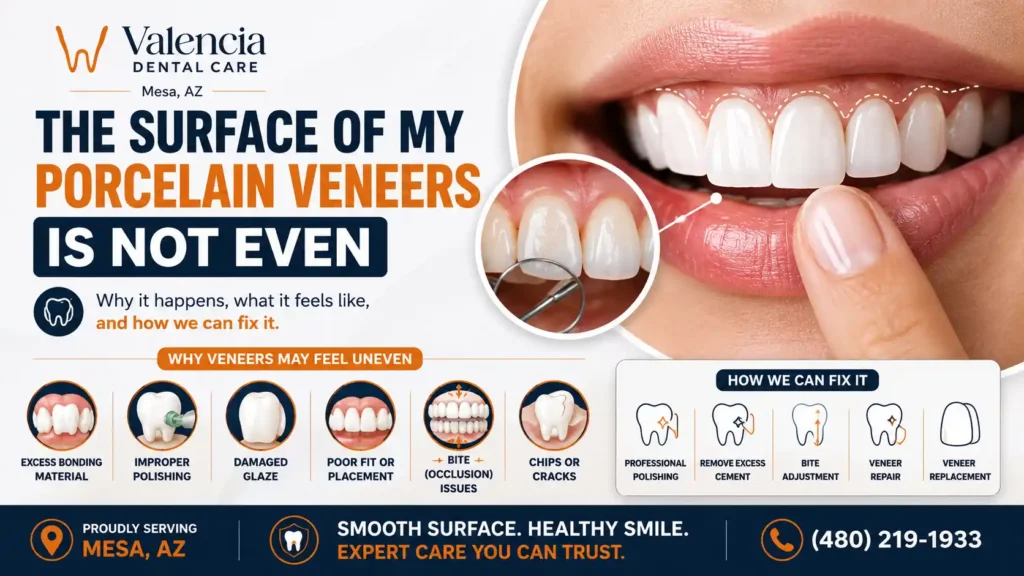




You invested in porcelain veneers expecting a smooth, natural-looking smile. Instead, your veneers feel rough when you run your tongue across them, seem uneven compared to your natural teeth, or even look slightly dull or pasty. It’s understandable to wonder whether something went wrong or if this is simply part of the adjustment process.
The good news is that porcelain veneers should normally feel smooth and polished. In many cases, roughness has an identifiable cause, such as excess bonding material, an imperfect polish, damage to the porcelain glaze, or a veneer that wasn’t finished correctly. At Valencia Dental Care in Mesa, AZ, we often help patients understand whether these concerns are part of a normal adjustment period or signs that their veneers need professional evaluation.
In this guide, you’ll learn why porcelain veneers may feel rough, whether the condition is normal, when polishing is appropriate, and what treatment options are available. We’ll also explain the warning signs that indicate it’s time to seek professional care, answer the most common questions patients ask after getting veneers, and help you understand when it’s worth seeking advice from an experienced cosmetic dentist.
Real Patient Question
Patient Question
My porcelain veneers do not feel smooth on my five upper, front teeth. Basically, when I run my teeth over them, they do not feel slick like my normal teeth. I have gone back to the dentist who did them to have them polished two times. Also, I think they look pasty.
-Carrie from California
Expert Dentist Answer
Dear Carrie,
Unfortunately, from what you have described it does not sound as if your dentist knows how to polish your porcelain veneers. Another issue could be that he originally used a laboratory that may not have made the most natural-looking veneers.
Many general dentists claim that they can do porcelain veneers. The problem is that they need to look as life-like as possible. It truly takes an “artist” to perfect this technique. That is why there is so much additional training and education to be considered a cosmetic dentist.
Porcelain veneers do not require polish. The process in which they are made when fired in the porcelain oven gives them a glaze. This coating is very stain-resistant and durable. There are occasions where polishing is required when a dentist who is maintaining them does not treat them properly. However, there is also a special polishing toothpaste for veneers. You can try it for the best results as well.
I would recommend consulting with a true cosmetic dentist. They should be able to polish them properly and ultimately give you the natural, beautiful look you are after.
The Anticipation of Silky-Smooth Veneers:
For individuals investing in smooth veneers, the expectation often revolves around achieving a seamlessly smooth surface, mimicking the natural texture of teeth. This expectation is grounded in the desire for a smile that not only looks impeccable but also feels comfortable and natural.
Common Concerns: When Smooth Turns Bumpy:
Despite meticulous planning and skilled craftsmanship, some individuals find themselves facing the unexpected realization that their porcelain veneers do not exhibit the desired smoothness and their back of veneer feels rough. Instead, concerns may arise about uneven surfaces, irregular textures, or an overall rough feel, leading to questions about the root causes of these imperfections.
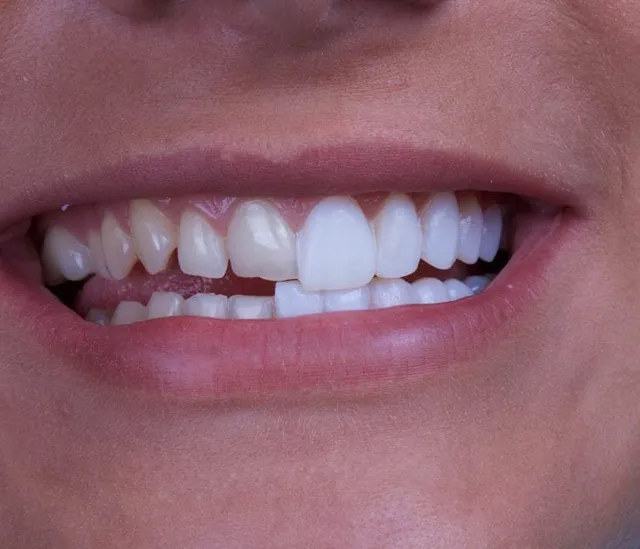
Should Porcelain Veneers Feel Smooth?
Yes. Properly made porcelain veneers should feel smooth, glossy, and comfortable after the initial adjustment period. Once bonded to your teeth, they should closely mimic the texture of natural enamel without feeling rough, gritty, or bulky. Immediately after your veneers are placed, it’s common to notice that they feel slightly different simply because your tongue is adjusting to a new tooth shape. Most patients stop noticing this difference within a few days or weeks as the brain adapts to the new surfaces.
However, there’s an important difference between feeling unfamiliar and feeling rough. If your veneers consistently feel rough when you slide your tongue across them, catch on dental floss, or have uneven edges that irritate your lips or cheeks, the problem should not be ignored. These symptoms often indicate that the veneer surface, bonding material, or finishing process needs professional evaluation.
High-quality porcelain veneers are carefully fabricated and glazed in a dental laboratory to create a hard, stain-resistant surface that reflects light similarly to natural enamel. When designed and placed correctly, they should feel almost indistinguishable from healthy teeth while maintaining a natural appearance for many years.
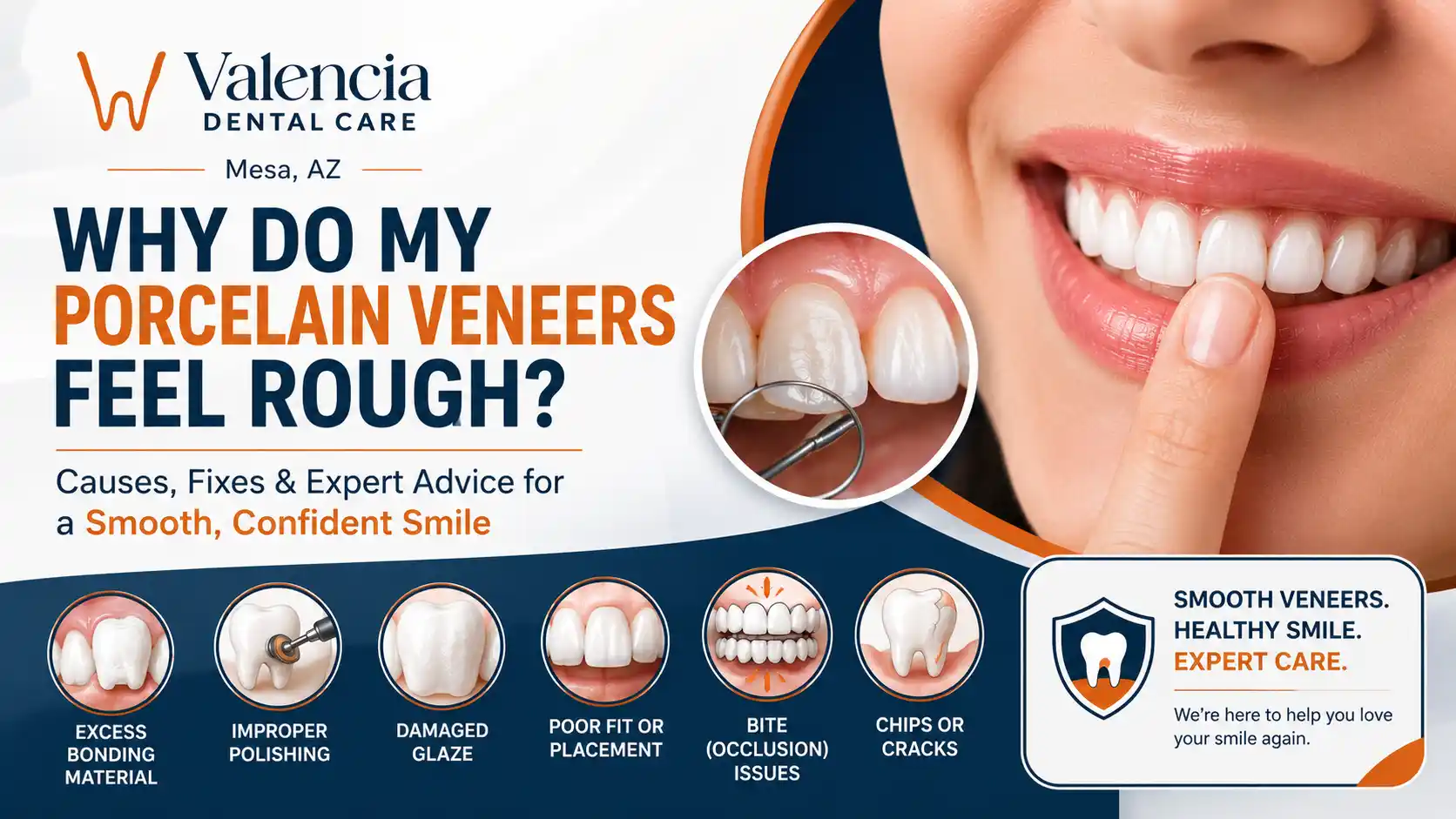
Why Do My Porcelain Veneers Feel Rough?
There isn’t a single explanation for rough porcelain veneers. In most cases, the cause falls into one of several common categories, and identifying the correct reason is the first step toward choosing the appropriate treatment.
1. Excess Bonding Material
During veneer placement, your dentist uses a strong dental resin cement to permanently bond the veneer to your tooth. If small amounts of bonding material remain around the edges, they can create a rough or raised feeling when your tongue touches the veneers.
Fortunately, this is often one of the easiest issues to correct. A cosmetic dentist can carefully remove excess bonding material without damaging the porcelain, restoring a smoother feel and improving overall comfort.
2. The Porcelain Glaze Has Been Damaged
Porcelain veneers leave the dental laboratory with a highly polished, glazed surface designed to resist staining and mimic natural enamel. If that glaze becomes damaged through improper adjustments, aggressive polishing, or accidental wear, the veneer may begin to feel rough or lose some of its natural shine.
In some situations, professional polishing can restore the surface. If the damage is extensive, however, replacement may provide the best long-term result.
3. Improper Veneer Placement
Even a beautifully crafted veneer can feel uncomfortable if it isn’t positioned correctly. During placement, every veneer must align precisely with your natural teeth, bite, and gum line. A slight misalignment can leave one edge feeling higher than the surrounding teeth or create an uneven transition that your tongue notices every time you speak or eat.
Signs of improper placement include:
- One veneer feels rough while the others feel smooth.
- Your tongue constantly catches on a specific edge.
- Floss shreds or catches between the veneer and adjacent tooth.
- Your bite feels different after treatment.
In many cases, a cosmetic dentist can make minor adjustments to improve comfort. If the veneer was bonded incorrectly or doesn’t fit properly, replacement may be the better long-term solution.
4. Poor Laboratory Craftsmanship
The quality of your veneers depends not only on your dentist’s skill but also on the dental laboratory that fabricates them. High-end cosmetic laboratories carefully design, contour, and glaze porcelain veneers to create a surface that closely resembles natural enamel. Lower-quality fabrication may leave subtle irregularities in texture, shape, or translucency, making veneers feel rough or appear unnaturally opaque.
This is one reason experienced cosmetic dentists often work with specialized laboratories rather than mass-production facilities. If your veneers feel rough and look flat, chalky, or overly white, the issue may originate from the way they were manufactured rather than how they were placed.
5. Bite Problems (Occlusion)
Your bite plays an important role in how veneers feel. If your upper and lower teeth don’t come together evenly, excessive pressure may be placed on one or more veneers. Over time, this can create tiny chips, wear the polished surface, or cause you to notice rough edges that weren’t present immediately after treatment.
Common signs include:
One veneer feels rough after several months, Clicking or discomfort while chewing, Jaw soreness. Teeth touching unevenly and a veneer that feels “high” when you bite down. A bite adjustment performed by a qualified cosmetic dentist can often relieve these problems before they become more serious.
6. Small Chips or Surface Damage
Porcelain is highly durable, but it isn’t indestructible. Biting hard objects such as ice, pens, popcorn kernels, or hard candy can create tiny chips along the edges of a veneer. Even a small defect can feel surprisingly rough to your tongue.
Other possible causes include:
Teeth grinding (bruxism)
Sports injuries
Accidental trauma
Using teeth to open packages
Minor chips may be polished if enough healthy porcelain remains. Larger fractures usually require replacement to restore strength and appearance.
Common Causes of Rough Porcelain Veneers
|
Cause |
Common Symptoms |
Can It Be Fixed? |
|
Excess bonding material |
Rough edges, floss catches |
Usually yes |
|
Improper veneer placement |
Uneven bite, rough margins |
Often yes |
|
Damaged porcelain glaze |
Dull appearance, rough texture |
Sometimes |
|
Poor laboratory fabrication |
Rough feel, unnatural appearance |
Often requires replacement |
|
Small chips or fractures |
Sharp or gritty areas |
Depends on severity |
|
Bite problems |
One veneer wears faster than others |
Usually yes |
|
Normal adjustment period |
Feels different for a few days |
Improves naturally |
How Can Rough Porcelain Veneers Be Fixed?
The best treatment depends entirely on what’s causing the roughness. Some veneers only need a simple adjustment, while others may require repair or replacement. An experienced cosmetic dentist will identify the underlying issue before recommending any treatment.
Because every veneer is custom-made, there’s no one-size-fits-all solution. The goal is always to preserve the existing veneer whenever possible while restoring a smooth, natural feel.
Professional Polishing
Professional polishing is often the first treatment considered when the veneer itself is healthy and only the outer surface feels slightly rough. Minor scratches, small imperfections created during finishing, or slight roughness after a bite adjustment can often be corrected without replacing the restoration. Dentists use specialised polishing systems designed specifically for porcelain, which differ significantly from the instruments used on natural teeth. When performed correctly, professional polishing can restore the veneer’s smooth, glossy finish while preserving the integrity of the porcelain and improving overall comfort.
Removing Excess Bonding Material
Sometimes the veneer isn’t the problem at all. During placement, dentists use resin cement to permanently bond the veneer to the tooth, and even a very small amount of excess bonding material around the edges can create a rough or raised feeling. Although this may seem like a major issue to patients, it’s often one of the simplest problems to correct. After carefully examining the veneer margins, your dentist can remove the excess cement using fine finishing instruments, allowing the veneer to feel significantly smoother without affecting the porcelain itself.
Bite Adjustment
There are situations where the veneer feels rough because your bite is placing too much pressure on a specific area rather than because the porcelain surface is damaged. If your upper and lower teeth do not meet evenly, one veneer may experience excessive force during chewing, gradually creating discomfort or making the surface feel uneven. In these cases, your dentist may recommend a conservative bite adjustment to improve how your teeth come together. Correcting the bite not only restores comfort but also helps protect the veneers from unnecessary wear and reduces the risk of future chipping.
Veneer Repair
Not every damaged veneer needs to be replaced. If the roughness is caused by a small chip or a minor defect along the edge, your cosmetic dentist may be able to smooth the affected area or perform a conservative repair, depending on the location and extent of the damage. These treatments are generally suitable for small cosmetic imperfections that do not compromise the overall strength of the veneer. However, if the porcelain has sustained significant damage or the structural integrity of the restoration has been affected, repairing it may not provide a predictable long-term outcome.
Veneer Replacement
In some situations, replacing the veneer is the most reliable solution. This may be necessary when the porcelain glaze has been permanently damaged, the veneer was poorly fabricated, the fit is inaccurate, or cracks extend through the ceramic material. Replacement may also be recommended if repeated polishing or adjustments have failed to resolve the roughness or improve the appearance. Although replacing a veneer requires additional time and planning, it often delivers the most predictable long-term result when the existing restoration cannot be successfully restored. Before making that recommendation, an experienced cosmetic dentist will carefully assess the condition of the veneer to determine whether replacement is truly the best option.
What Should You Avoid If Your Veneers Feel Rough?
Many patients unknowingly make the problem worse by trying to fix rough veneers themselves. Until you’ve been evaluated by your dentist, avoid the following:
Don’t Use Abrasive Toothpaste
Whitening or highly abrasive toothpaste can gradually wear the polished surface of porcelain. Choose a non-abrasive toothpaste recommended for cosmetic dental restorations whenever possible.
Don’t File or Polish Your Veneers at Home
It may be tempting to smooth a rough edge using a nail file or polishing product found online. Never attempt this. Home polishing permanently removes porcelain and can damage the glaze that protects the veneer. Once that surface is removed, it cannot simply be brushed back to its original condition.
Don’t Ignore Sharp Edges
If a veneer feels sharp enough to irritate your tongue or cheek, schedule an appointment instead of hoping the problem disappears. Persistent irritation can make eating and speaking uncomfortable and may indicate that the veneer needs professional adjustment.
Poor bonding between the veneers and the natural teeth can result in uneven surfaces. If the bonding process is not executed meticulously, it may lead to variations in texture.
Navigating the Concerns: A Collaborative Approach:
Open Communication with the Dentist:
Communication is key. Express concerns about the texture with your dentist, providing specific details about areas of discomfort or unevenness. This dialogue establishes the foundation for addressing the issue collaboratively.
Comprehensive Examination:
A thorough examination by the dentist is crucial. This may involve diagnostic tools, such as digital imaging or intraoral scans, to pinpoint the exact areas that require attention.
Potential Adjustments:
Depending on the assessment, adjustments may be possible. This could involve refining the bonding, reevaluating the alignment, or making subtle modifications to the veneers to achieve the desired smoothness.
Consideration of Refinement Procedures:
In some cases, refinement procedures may be recommended. These can include polishing the veneers or addressing any irregularities in the bonding for a smoother finish.
Patient-Centric Solutions: Empowering a Satisfactory Outcome:
Empowered by open communication and a collaborative approach, individuals experiencing concerns about the smoothness of their porcelain veneers can actively participate in the quest for a satisfactory outcome. Working hand-in-hand with the dentist ensures that refinements align with personal expectations, leading to a smile that not only looks beautiful but feels impeccably smooth.
How Do Veneers Feel?
The sensation and feel of veneers can vary from person to person, and individuals may experience an adjustment period as they get used to the presence of these cosmetic enhancements. Here are some common aspects related to how veneers feel:
- Smooth Texture: Porcelain veneers are designed to have a smooth surface, often mimicking the natural texture of teeth. The initial feel is generally smooth against the tongue and lips.
- Thin Profile: Veneers are thin shells that are custom-made to fit over the front surface of the teeth. Due to their minimal thickness, they typically don’t feel bulky or overly intrusive.
- Comfortable Bite: Properly fitted veneers should not interfere with your bite. Dentists ensure that the veneers are aligned correctly to maintain a comfortable and natural bite.
- Increased Sensitivity: Some individuals may experience temporary increased sensitivity to hot or cold temperatures immediately after getting veneers. This sensitivity is often mild and tends to subside as the mouth adjusts.
- Adjustment Period: It’s normal to have an adjustment period during which you become accustomed to the feel of the veneers. Initially, you may be aware of their presence, but over time, they should feel like a natural part of your teeth.
Conclusion
Porcelain veneers are designed to have a naturally smooth, glossy surface that closely resembles healthy tooth enamel. If your veneers feel rough, uneven, or different from your natural teeth long after placement, don’t ignore it. The issue may be related to polishing techniques, bonding errors, veneer fabrication, or placement accuracy rather than the porcelain itself. An experienced cosmetic dentist can evaluate the cause and determine whether professional polishing, adjustment, repair, or replacement is the best solution. Addressing the problem early not only improves comfort and appearance but also helps protect the long-term success of your veneers and keeps your smile looking its best.
Concerned About Rough or Uneven Porcelain Veneers? We’re Here to Help.
If your porcelain veneers still feel rough, uneven, or simply don’t look or feel the way you expected, you don’t have to live with the discomfort or uncertainty. At Valencia Dental Care, our experienced cosmetic dentistry team takes the time to identify the underlying cause and recommend the most appropriate solution, whether that’s a simple adjustment, professional polishing, or replacing a veneer when necessary. Our goal is to help you achieve a smile that not only looks beautiful but also feels smooth, comfortable, and completely natural.
If you’re looking for a trusted cosmetic dentist in Mesa, AZ, we’re here to help. Schedule a consultation at Valencia Dental Care to receive a comprehensive evaluation and personalised treatment plan designed to restore your confidence and protect your investment in your smile.
Frequently Asked Questions
Why do my porcelain veneers feel rough?
Porcelain veneers should normally feel smooth and glossy. If they feel rough, the cause may be excess bonding material, improper polishing, a damaged porcelain glaze, bite interference, or a chipped veneer. A cosmetic dentist can determine the exact cause and recommend the most appropriate treatment.
Is it normal for porcelain veneers to feel rough after placement?
It’s common for new veneers to feel slightly different during the first few days because your tongue is adjusting to their new shape. However, they should not feel rough, sharp, or gritty. If the roughness continues beyond the initial adjustment period, schedule a follow-up appointment with your dentist.
Should porcelain veneers feel as smooth as natural teeth?
Yes. High-quality porcelain veneers are designed to closely mimic the smooth texture and glossy appearance of healthy tooth enamel. Once you’ve adjusted to them, they should feel comfortable and natural when speaking, eating, or running your tongue across them.
Can rough porcelain veneers be polished?
Yes, but only when the roughness is caused by minor surface imperfections or finishing issues. Professional polishing should only be performed by a dentist experienced in cosmetic dentistry using polishing systems specifically designed for porcelain restorations.
Why does the back of my veneer feel rough?
The back or edge of a veneer may feel rough if excess bonding cement remains after placement, the veneer margin isn’t perfectly finished, or a small chip has developed. Your dentist can examine the area and determine whether it can be corrected with a simple adjustment.
Can veneers become rough over time?
Yes. Although porcelain is highly durable, veneers may become rough over time due to normal wear, teeth grinding, accidental chips, bite changes, or damage to the glazed surface. Regular dental checkups help identify these problems early.
Can I polish my porcelain veneers at home?
No. Home polishing products and abrasive materials can permanently damage porcelain veneers by removing their protective glazed surface. If your veneers feel rough, it’s safest to have them evaluated by your dentist rather than attempting to polish them yourself.
Will rough veneers damage my natural teeth?
The roughness itself usually doesn’t damage your natural teeth. However, rough edges may irritate your tongue, cheeks, or gums, and bite problems associated with poorly fitting veneers can place unnecessary pressure on surrounding teeth. Early treatment helps prevent additional complications.
When should a rough veneer be replaced instead of repaired?
Replacement may be recommended if the veneer has a significant crack, severe surface damage, poor fit, or an unnatural appearance that cannot be corrected through polishing or minor adjustments. Your dentist will evaluate whether repair or replacement offers the best long-term outcome.
Can teeth grinding make veneers feel rough?
Yes. Bruxism can gradually wear the surface of porcelain veneers or create tiny chips along the edges, making them feel rough over time. Wearing a custom night guard may help protect both your veneers and your natural teeth if you grind while sleeping.
What should I do if only one veneer feels rough?
If only one veneer feels rough while the others feel normal, the issue is usually isolated to that specific restoration. Common causes include excess bonding material, a chipped edge, bite interference, or a minor manufacturing defect. A cosmetic dentist can evaluate the veneer and recommend the appropriate treatment.