





When treating a single discoloured tooth, dentists usually follow a step-by-step plan. They start with the simplest and least painful treatment first. Today, many people care about how their smile looks. A dead discoloured tooth can be whitened in many cases, but the process is completely different from what most people expect. That is why tooth whitening is a common way to fix tooth colour and remove stains.
It is important to know why a tooth becomes discoloured and what treatment options are available. For patients in Mesa, AZ, if one of your teeth is turning grey or darker than the others, it may not just be a cosmetic problem, it could be a dead tooth.
 What Is a Dead Discoloured Tooth?
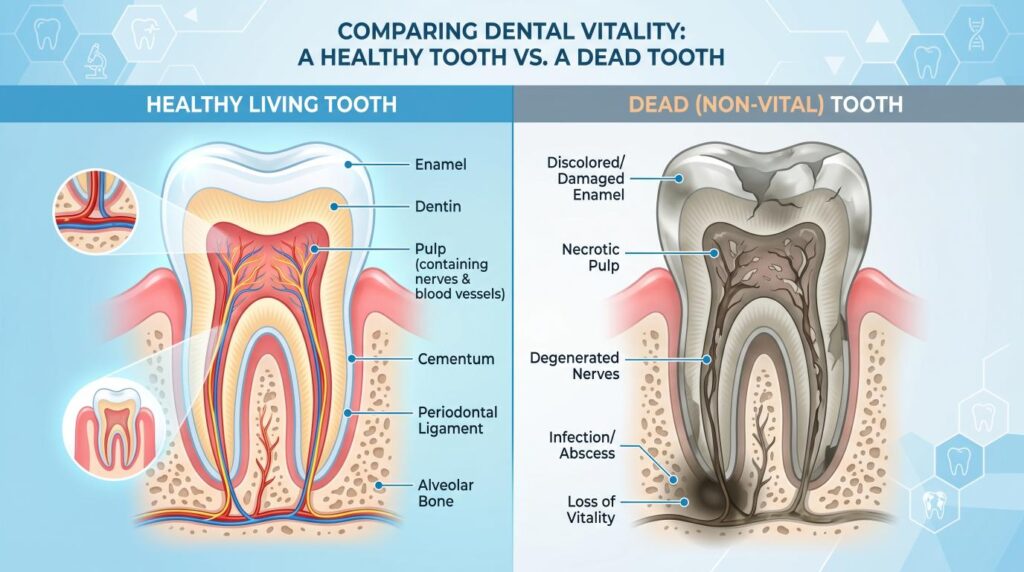
A dead tooth is one where the nerve and blood supply inside the tooth have stopped working. Dentists call it a non-vital tooth. When a tooth is alive and healthy, it gets a constant flow of blood that keeps the inner tissue called the pulp healthy.
The signs of a dead tooth include a visible colour change in just one tooth, a bad taste or smell coming from that tooth, occasional pain or pressure, and in some cases no pain at all. Some people feel no discomfort even when the tooth is fully non-vital, which is why the colour change is often the first warning sign they notice.
Can a Dead Discoloured Tooth Be Whitened?
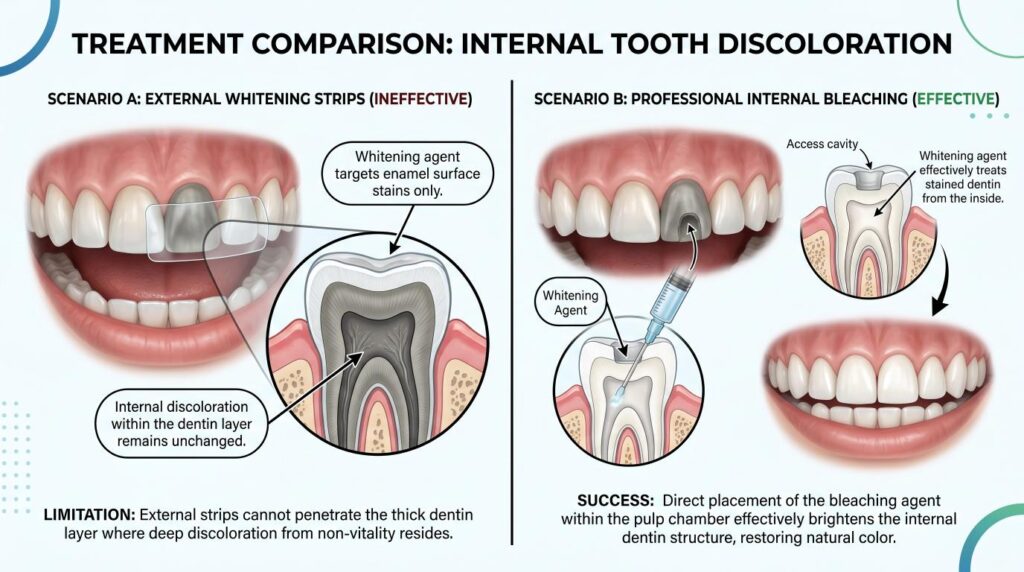
Standard whitening treatments, including whitening strips, toothpastes, and even professional whitening gels, work by penetrating the outer enamel and breaking down surface stains. They are designed for living teeth where the discoloration comes from outside sources like food, coffee, or tobacco. A dead tooth is a different situation entirely. The discoloration is internal. It is happening in the denting layer beneath the enamel, not on top of it.
Why Do Teeth Become Dead and Discoloured?
A dead tooth can happen for several reasons. One of the most common causes is tooth trauma or injury from sports, falls, or accidents. An injury can damage the blood vessels inside the tooth, and the nerve may die slowly over time. Sometimes the tooth does not darken until months or even years later.
Untreated cavities can also spread deep into the tooth and infect the inner pulp, cutting off the blood supply. In some cases, problems after a root canal, repeated dental work, or long-term teeth grinding can damage the tooth nerve and cause the tooth to become dark or discoloured.
Treatment Options for a Dead Discoloured Tooth
Treatment options for a dead discoloured tooth include internal bleaching, dental bonding, veneers, or a crown depending on how severe the discolouration is.
 Internal Bleaching (Root Canal Whitening)
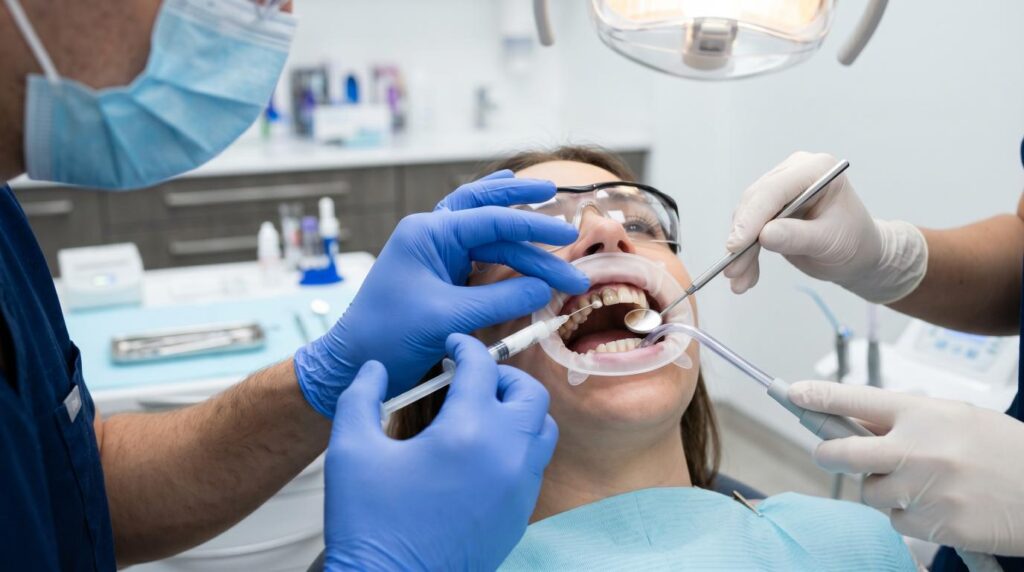
Internal bleaching is the most direct way to whiten a dead tooth. It works from the inside, which is exactly where the staining is coming from. The dentist starts by performing a root canal if one has not already been done. The root canal removes the dead tissue from inside the tooth and seals the root.
Once the inside is clean, the dentist makes a small opening in the back of the tooth, places a protective barrier over the root canal filling, and puts a professional-strength bleaching agent, usually sodium perpetrate mixed with hydrogen peroxide, directly into the pulp chamber. The tooth is then sealed temporarily and the bleaching agent is left inside for several days.
 Dental Bonding (Composite Covering)
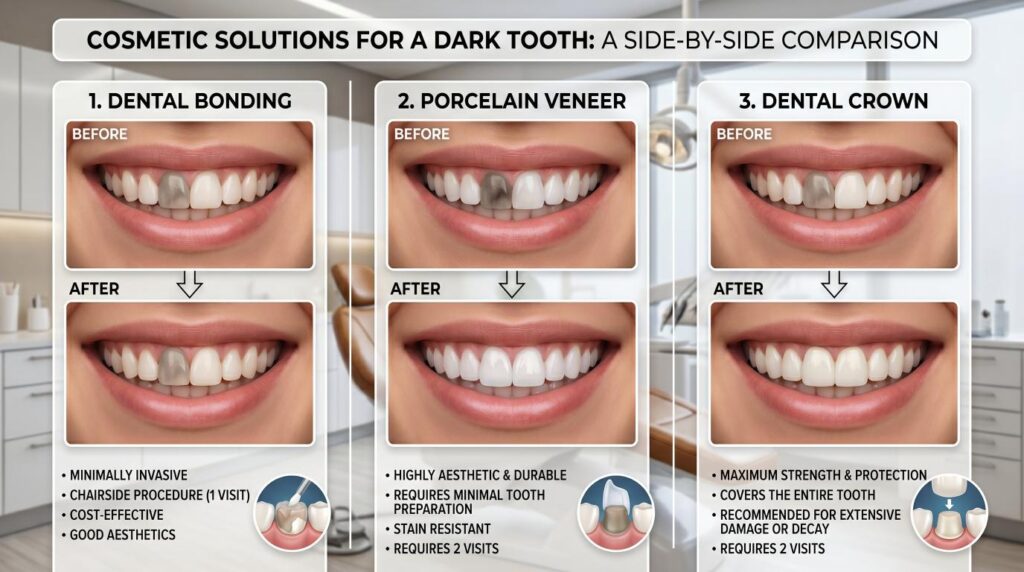
Dental bonding uses a tooth-coloured composite resin material that is applied directly to the front surface of the discoloured tooth. The dentist shapes and polishes it to blend with the surrounding teeth.
Bonding is a good option for mild to moderate discoloration and it is less expensive than veneers or crowns. However, composite resin is known to pick up stains over time and may need to be replaced or touched up after several years.
Porcelain Veneers
A veneer is a thin shell of porcelain that is permanently bonded to the front surface of the tooth. It covers the discoloration completely and looks very natural. Veneers are a strong cosmetic solution for front teeth. They last much longer than bonding, resist staining well, and can be colour-matched precisely to your other teeth.
The downside is that a small amount of enamel needs to be shaved off the tooth surface to make room for the veneer, which makes the process permanent. For dead teeth that are visible when you smile, veneers offer a reliable long-term appearance improvement without requiring full coverage of the entire tooth.
Dental Crowns
A dental crown covers the entire visible portion of the tooth. It is the strongest option and is typically recommended when the dead tooth is severely damaged, structurally weak, or very dark. Dead teeth are more brittle than living teeth because they no longer receive nutrients from the blood supply.
This makes them more prone to cracking under pressure. A crown not only solves the colour problem but also provides protection against breakage. Porcelain or porcelain-fused-to-metal crowns can be made to match the colour of neighbouring teeth very closely.
Which Treatment Is Best for You?
The amount of discoloration matters. A tooth that has just started to turn yellow may respond well to internal bleaching. A tooth that has gone dark grey or nearly black will likely need a veneer or crown. The structural health of the tooth plays a big role too. If the tooth is cracked or significantly weakened, a crown makes more sense than bleaching alone.
Your budget and personal goals factor in as well. Bonding is the most affordable, crowns are the most expensive, and veneers sit in between. Your dentist will also need to check whether a root canal has already been done and whether the root is healthy enough to support any of these treatments.
 Why Normal Teeth Whitening Does Not Work on Dead Teeth
Whitening strips and gels use hydrogen peroxide or carbide peroxide to lift surface stains from living enamel. These products work by penetrating the outer enamel layer and breaking up stain molecules. They can brighten teeth that are stained from food, drinks, or tobacco.
A dead tooth has a different kind of discoloration. The colour is coming from the breakdown of blood cells and nerve tissue deep inside the tooth, in the dentine. Even the strongest professional whitening gels applied to the outside of a dead tooth will have very little effect on the internal darkness.
What Results Can You Expect?
Realistic expectations help a lot when it comes to dead tooth treatment. Internal bleaching can improve the shade significantly, often bringing a tooth several shades lighter. Some teeth respond very well and achieve a natural colour. Others improve only partially. In these cases, the dentist may follow up internal bleaching with a veneer or crown to complete the correction.
Colour improvement from internal bleaching tends to be noticeable, but results are not always permanent. Some teeth slowly darken again over a couple of years. Veneers and crowns offer more predictable and longer-lasting colour results because the discoloration is physically covered rather than chemically treated.
Can a Dead Tooth Be Saved or Only Covered?
Internal bleaching saves the natural tooth and improves its colour from the inside. This is the most conservative option and the preferred choice when the tooth is healthy enough structurally. When bleaching is not sufficient, a veneer or crown covers the tooth while still preserving it. The natural tooth remains in place, protected underneath the restoration.
Extraction is only considered in rare cases, usually when the tooth is severely damaged, infected beyond treatment, or when the root cannot support any restoration. If a tooth does need to be removed, implants and bridges are available options to restore the space.
Risks and Side Effects of Treatment
Internal bleaching is generally well tolerated. Some patients experience mild sensitivity after the procedure, though dead teeth often have no sensation at all. In rare cases, internal bleaching can lead to a condition called cervical root resorption, where the root tissue starts to break down over time.
Results from internal bleaching may not be permanent. Some teeth gradually darken again over a few years, which means the procedure may need to be repeated or followed up with a veneer or crown.
How Dentists Decide the Right Treatment
Before any treatment begins, the dentist will do a thorough examination. This includes X-rays to check the root, the surrounding bone, and whether any infection is present. They will also check if a root canal has already been done and whether the seal is still intact.
They will look at the colour and depth of discoloration, the structural integrity of the tooth, and its position in the mouth. A tooth that is at risk of infection needs to be treated medically before any whitening can happen. Once the tooth is stable, the cosmetic options can be explored.
When Should You See a Dentist?
You should see a dentist promptly if one tooth is noticeably darker than the rest, especially if the change came on gradually or started after an injury. Do not wait until you feel pain, because dead teeth often cause no discomfort at all.
You should also go in if you notice a bad taste or smell coming from one area of your mouth, if there is swelling around the gum near a tooth, or if a tooth has been darkening since a root canal was done. These can all be signs of infection that need attention before any whitening treatment can begin.
Is a Dead or Discoloured Tooth Affecting Your Smile?
If one of your teeth is turning dark and whitening products are not working, the problem is almost certainly coming from inside the tooth and needs professional care. Valencia Dental Care serves patients across Mesa, AZ. Book your appointment and Our team will evaluate your tooth, explain your options, and help you get your smile back.
Conclusion
A dead discoloured tooth can absolutely be whitened in many cases, but it requires the right treatment. Standard whitening products will not work because the discoloration is happening inside the tooth, not on the surface. The actual options, including internal bleaching, dental bonding, porcelain veneers, or crowns, depend on the level of darkening, the health of the tooth, and your cosmetic goals.
The most important step is to see a dentist who can evaluate your specific situation with X-rays and a proper examination. Do not guess at home or assume nothing can be done. In most cases, a dead tooth can either be whitened from the inside or covered in a way that blends seamlessly with the rest of your smile. You have more options than you think.
Frequently Asked Questions
Can a dead tooth be whitened at home?
No. At-home strips and whitening pens only work on surface stains. Dead tooth discoloration comes from inside, so professional treatment is the only reliable option.
Does internal bleaching hurt?
Generally no. Dead teeth have no live nerves, so most patients feel nothing. Mild gum sensitivity is possible but temporary.
How long does whitening a dead tooth last?
Anywhere from one to several years. If the tooth darkens again, the procedure can be repeated or a veneer or crown can be placed for a longer lasting result.
Is a crown better than whitening for a dead tooth?
It depends. Bleaching works when the tooth is structurally healthy. A crown is better when the tooth is very dark, cracked, or weakened. Your dentist will decide based on your specific case.
Can a dead tooth fall out?
Not immediately, but dead teeth become more brittle over time and are more prone to cracking. Timely treatment, whether a root canal, crown, or other option, significantly reduces that risk.