
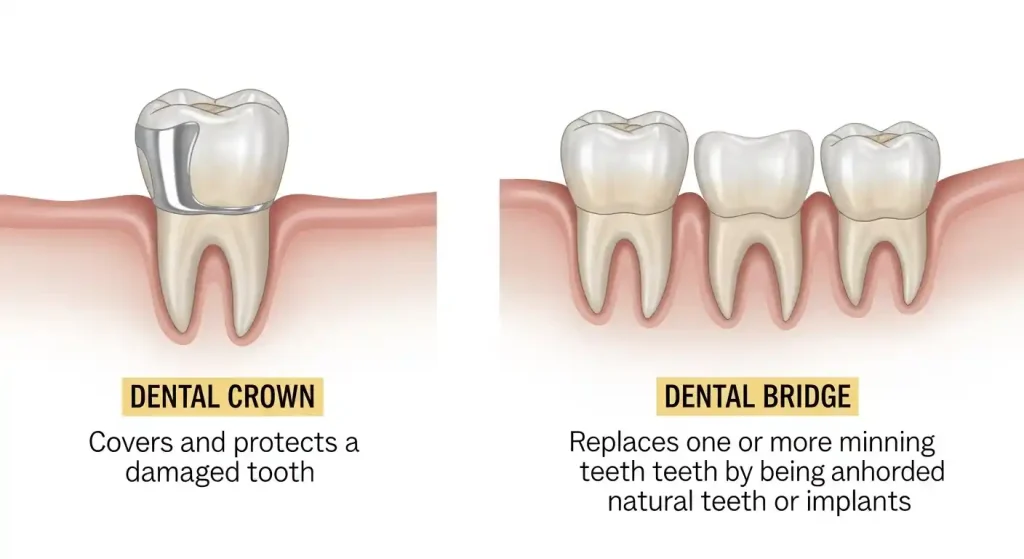


A dental crown restores a damaged or weakened tooth by covering it with a protective cap, while a dental bridge replaces one or more missing teeth by anchoring an artificial tooth to the surrounding natural teeth. In simple terms, a crown saves a tooth that is still there, and a bridge fills the gap when a tooth is gone.
If you’ve been told you need one of these treatments in Mesa, AZ, the decision can feel confusing and sometimes stressful. The wrong choice (or delaying care) can lead to shifting teeth, bite problems, or further damage. Understanding how crowns and bridges differ in purpose, cost, longevity, and impact on nearby teeth helps you make a confident, informed decision about restoring your smile.
Quick Comparison Table: Dental Crown vs Dental Bridge
| Feature | Dental Crown | Dental Bridge |
| Purpose | Restore a damaged tooth | Replace a missing tooth |
| Teeth involved | One | Three or more |
| Impact on adjacent teeth | None | Adjacent teeth are filed down |
| Longevity | 10–15 years | 10–15 years |
| Cost range | $1,000–$3,500 per tooth | $2,500–$6,000+ |
| Best use case | Cracked, decayed, or weakened tooth | One or more missing teeth |
What Is a Dental Crown?

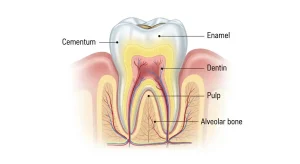
A dental crown is a tooth-shaped cap that covers the entire visible portion of a tooth above the gum line. It fully encases the tooth, restoring its original shape, size, and strength. Crowns are custom-made in a dental lab to match the color and contour of your surrounding teeth, allowing them to blend naturally with your smile.
Crowns do not replace a missing tooth they protect and rebuild one that still has an intact root. Think of a crown as a helmet for a tooth that has been damaged but not lost.
When Do You Need a Dental Crown?
There are several situations where a dentist may recommend a crown. One of the most common is a cracked or fractured tooth; a crown holds the tooth together and helps prevent the crack from extending deeper toward the root. A large cavity that cannot be properly restored with a standard filling may also require a crown, as the remaining tooth structure may not be strong enough to support a filling long term.
After a root canal, the tooth can become more brittle because the inner pulp has been removed. Placing a crown restores strength and protects the treated tooth from breaking. Crowns may also be used for cosmetic reasons, such as improving a severely discolored, misshapen, or undersized tooth that does not respond well to other treatments.
Types of Dental Crowns
Porcelain crowns are highly aesthetic and often recommended for front teeth because they closely match natural tooth color. However, they may be slightly less durable than some other materials. Zirconia crowns are extremely strong while still tooth-colored, making them a popular choice for both front and back teeth.
Metal crowns usually made from gold or other alloys are the most durable and require less tooth reduction, but their metallic appearance makes them less ideal for visible areas. Porcelain-fused-to-metal (PFM) crowns combine a strong metal base with a porcelain exterior for improved appearance, though a thin metal line may become visible near the gumline over time.
Advantages and Disadvantages of Dental Crowns
One major advantage of a crown is that it preserves your natural tooth root, which helps maintain jawbone health and prevent bone loss. Crowns are durable, long-lasting, and function much like a natural tooth. However, placing a crown requires removing a significant portion of the tooth structure, an irreversible process. Crowns can also chip or crack under heavy pressure, and if decay forms underneath, the tooth may eventually require extraction.
What Is a Dental Bridge?

A dental bridge literally bridges the gap left by a missing tooth. It consists of one or more artificial teeth (called pontics) held in place by dental crowns cemented to the natural teeth on either side of the space. Those supporting teeth, called abutments, are prepared the same way they would be for a regular crown by removing enamel to make room for the restoration.
The result is a fixed, non-removable prosthetic that looks and functions like natural teeth.
When Do You Need a Dental Bridge?
A dental bridge is recommended when one or more teeth are completely missing due to extraction, injury, or advanced decay that could not be saved. Replacing the missing tooth is important not only for appearance but also for maintaining proper function.
Another key reason to choose a bridge is to prevent neighboring teeth from shifting into the empty space. When a gap is left untreated, surrounding teeth can gradually drift out of position, leading to bite issues, jaw discomfort, and a higher risk of decay. A bridge fills the gap and helps keep your teeth properly aligned.
Types of Dental Bridges
A traditional bridge is the most common type, using crowns on the two adjacent teeth to support the artificial tooth (pontic) in between. A cantilever bridge attaches to only one neighboring tooth instead of two, making it useful when there is only one natural tooth next to the gap though it places more pressure on that single support tooth.
A Maryland bridge, also known as a resin-bonded bridge, uses metal or porcelain wings bonded to the back of adjacent teeth rather than full crowns, requiring less tooth preparation. An implant-supported bridge replaces multiple missing teeth by anchoring to dental implants instead of natural teeth, providing greater stability without affecting nearby healthy teeth.
Advantages and Disadvantages of Dental Bridges
Bridges restore chewing ability, improve speech, and help prevent surrounding teeth from shifting out of place. They are non-surgical, commonly available, and often partially covered by dental insurance. However, a major drawback is that healthy adjacent teeth must be permanently reshaped to support the bridge, even if they are undamaged.
Bridges also do not prevent jawbone loss in the missing tooth area, since there is no root structure to stimulate the bone. Over time, this may lead to subtle changes in the underlying facial structure.
Key Structural Differences Between a Crown and a Bridge
The fundamental difference between a crown and a bridge is restoring versus replacing. A crown strengthens and protects a tooth that still has a healthy root, while a bridge fills a gap where a tooth including its root is completely missing. This distinction affects long-term function and oral health.
Because a bridge depends on neighboring teeth for support, those teeth absorb additional biting forces over time, which may increase wear or stress. A crown, placed on a single tooth, does not shift pressure to surrounding teeth in the same way. Bone health is another important factor: a crown preserves natural bone stimulation through the existing root, whereas a bridge leaves the bone beneath the missing tooth unstimulated, leading to gradual bone loss after extraction.
Tooth preparation also differs significantly. A crown requires reshaping only one tooth. A bridge, however, involves reducing at least two adjacent teeth to serve as support anchors, permanently altering them in the process.
When Should You Choose a Crown vs a Bridge?
Choose a Crown If:
Your tooth is damaged but the root is still intact and healthy. Whether it’s a large cavity, a crack, or post-root-canal fragility, a crown gives that tooth a new lease on life without involving any neighboring teeth. You should also choose a crown when you simply want to strengthen a weakened tooth before it breaks entirely. Preventive crowning can save you from a more complex and costly extraction and replacement down the road.
Choose a Bridge If:
A tooth is completely missing and you want a fixed, non-removable replacement that doesn’t require surgery. Bridges are also the right choice if you’re not a candidate for dental implants due to insufficient bone density, health conditions, or budget constraints, and you want something more stable than a partial denture.
Cost of a Crown vs a Bridge
The cost of a dental crown varies based on factors such as the material selected, the location of the tooth, and your geographic area. Materials like porcelain or zirconia generally cost more than metal due to their aesthetic qualities and durability.
A dental bridge typically costs more than a single crown because it involves multiple teeth and additional laboratory work. Larger bridges or implant-supported options increase the overall investment due to added complexity and materials.
Dental insurance often covers a portion of both treatments after the deductible, but annual maximum limits may affect how much reimbursement you receive. Other factors influencing cost include the extent of tooth preparation, the need for additional procedures, the dental laboratory involved, and your provider’s location.
Treatment Process: What to Expect

Dental Crown Procedure
The process begins with a consultation and X-rays to ensure the tooth is suitable for a crown. At the preparation appointment, the tooth is carefully reshaped to create space for the restoration. An impression or digital scan is taken and sent to a dental lab, and a temporary crown is placed to protect the tooth. Once the custom crown is ready, it is fitted, adjusted for comfort and bite, and permanently cemented at a follow-up visit.
Dental Bridge Procedure
The bridge process starts with a comprehensive evaluation of the missing tooth area and the adjacent teeth. The supporting (abutment) teeth are reshaped to hold crowns, and impressions or digital scans are taken for lab fabrication. A temporary bridge is placed to protect the area while the final restoration is being made. At the final appointment, the bridge is carefully checked for proper fit and bite alignment before being securely cemented.
Longevity and Maintenance
How Long Do Crowns Last?
With proper care, dental crowns typically last 10 to 15 years, and in many cases even longer. Durability depends on the material used and your oral habits. Porcelain crowns may be more prone to chipping over time, while zirconia and metal crowns generally offer greater long-term strength.
How Long Do Bridges Last?
Dental bridges also last about 10 to 15 years on average. Their lifespan largely depends on the health of the supporting (abutment) teeth. If those teeth develop decay or gum disease, the stability of the bridge can be compromised.
How to Care for Crowns and Bridges
Both restorations require brushing twice daily, daily flossing, and regular dental checkups. Bridges need extra attention because food particles can collect beneath the artificial tooth (pontic). Floss threaders or water flossers are especially helpful for cleaning under a bridge. Limiting hard or sticky foods can also reduce the risk of chipping or loosening either restoration.
Risks and Potential Complications
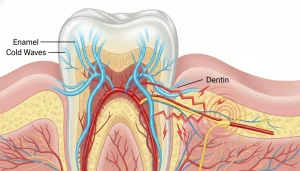
Both crowns and bridges carry some potential risks. Mild tooth sensitivity to hot or cold is common after placement and typically subsides within a few weeks. Gum irritation may occur if the edge of the restoration does not fit precisely along the gum line.
One of the more serious concerns is decay forming beneath the restoration. Because the natural tooth structure remains underneath, poor oral hygiene can allow cavities to develop unnoticed. Bridges also carry an added risk: the supporting teeth endure extra biting forces over time, which may increase wear or lead to structural problems if not properly maintained.
Are There Better Alternatives?
In many cases, dental implants are considered the gold standard for replacing missing teeth. A small titanium post is surgically placed into the jawbone, where it functions like a natural tooth root and helps preserve bone density all without relying on adjacent teeth for support. Although implants require a higher initial investment, they can be more cost-effective over the long term due to their durability.
Partial dentures offer a removable and more affordable option for replacing missing teeth, but they tend to be less stable and less comfortable than fixed restorations. Implant-supported bridges provide another alternative, combining the stability of implants with the ability to replace multiple consecutive missing teeth without reshaping healthy neighboring teeth.
Common Mistakes Patients Make When Choosing
One of the most common mistakes is deciding based on upfront cost alone. While a bridge may appear more affordable initially, long-term maintenance, potential replacement, or damage to supporting teeth can increase overall expenses over time. Focusing only on short-term savings may lead to more complex treatment later.
Another frequent mistake is neglecting maintenance. Cleaning around and beneath a bridge requires extra effort, and skipping proper flossing can lead to decay or gum disease that compromises the restoration. Perhaps the most harmful decision is delaying treatment altogether. When a missing tooth is left unaddressed, bone loss and shifting of nearby teeth can progress, making future solutions more complicated.
Both crowns and bridges are proven, reliable dental treatments but they address different needs. If your tooth is damaged but still intact, a crown strengthens and protects it. If a tooth is missing, a bridge restores the gap and improves function. The best choice comes from a thorough discussion with your dentist, considering your oral health, long-term goals, and overall treatment plan.
Ready to Restore Your Smile in Mesa, AZ?
Whether you need a dental crown to protect a damaged tooth or a bridge to replace a missing one, our team at Valencia Dental Care in Mesa, AZ is here to guide you through every step. You can easily book your appointment online and start your journey toward a stronger, healthier, and more confident smile today.
Conclusion
Choosing between a dental crown and a dental bridge ultimately comes down to whether you are restoring a damaged tooth or replacing a missing one. Crowns protect and strengthen teeth that still have healthy roots, while bridges fill gaps and restore function when a tooth is lost. Both treatments are reliable, long-lasting solutions when properly planned and maintained.
The right option depends on your oral health, the condition of surrounding teeth, your long-term goals, and your dentist’s professional evaluation. By understanding the structural differences, costs, longevity, and maintenance requirements, you can move forward with clarity and confidence in your decision.
Frequently Asked Questions
Is a crown better than a bridge?
Neither is universally better; they serve different purposes. A crown is best for protecting a damaged tooth, while a bridge is designed to replace a missing tooth. The right choice depends on your specific dental condition.
Does a dental bridge damage healthy teeth?
A traditional bridge requires reshaping the adjacent teeth to support it. While this is safe when properly done, it does permanently alter those teeth. That’s why treatment planning is important.
Which lasts longer, a crown or a bridge?
Both typically last 10 to 15 years with proper care. Longevity depends on oral hygiene, material used, bite pressure, and regular dental checkups.
Is getting a crown or bridge painful?
The procedures are performed under local anesthesia, so you should not feel pain during treatment. Some mild sensitivity or soreness afterward is normal and usually temporary.
Can a crown replace a missing tooth?
No. A crown can only restore a tooth that still has a natural root. If a tooth is completely missing, options include a bridge, dental implant, or partial denture.